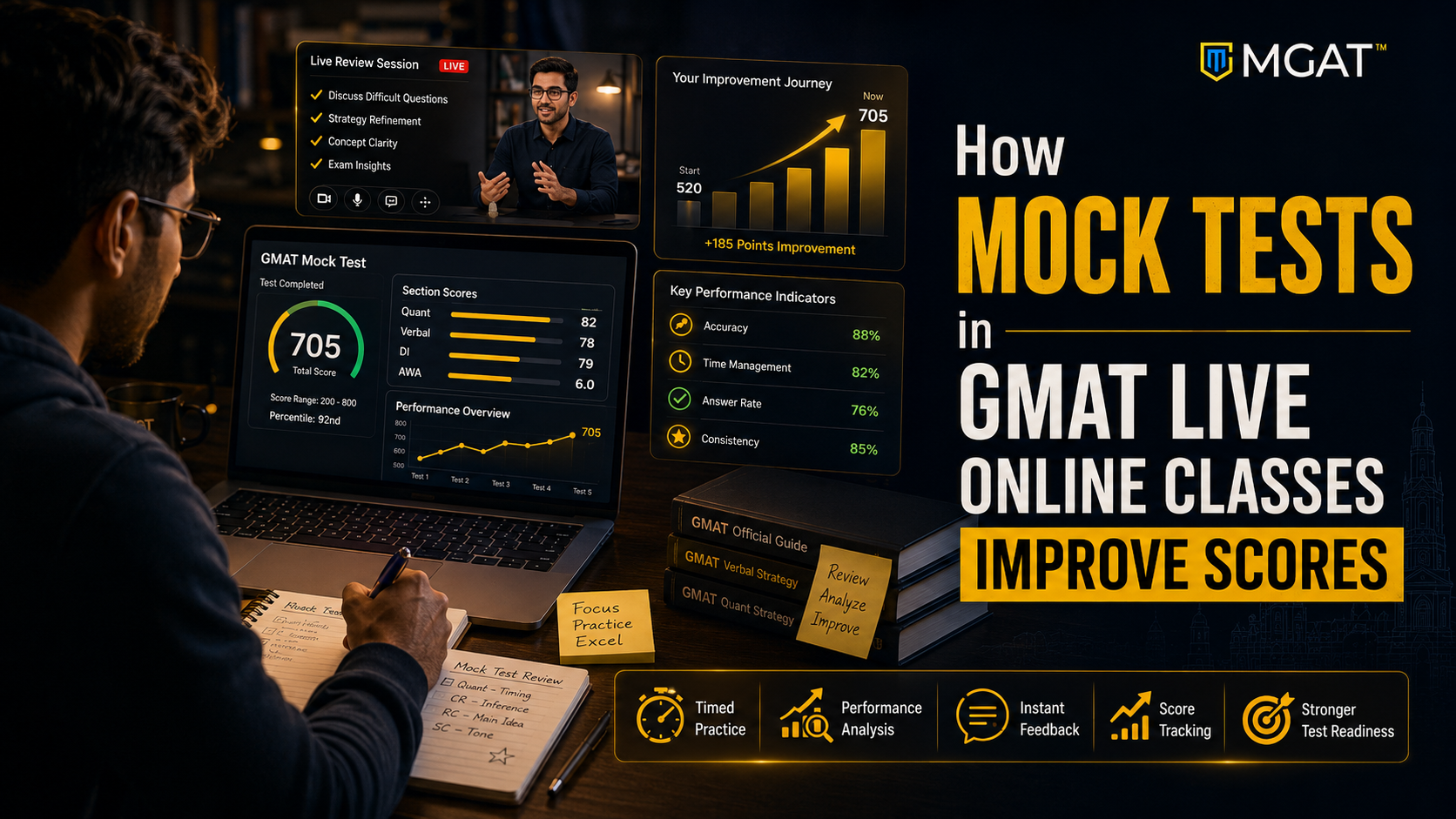
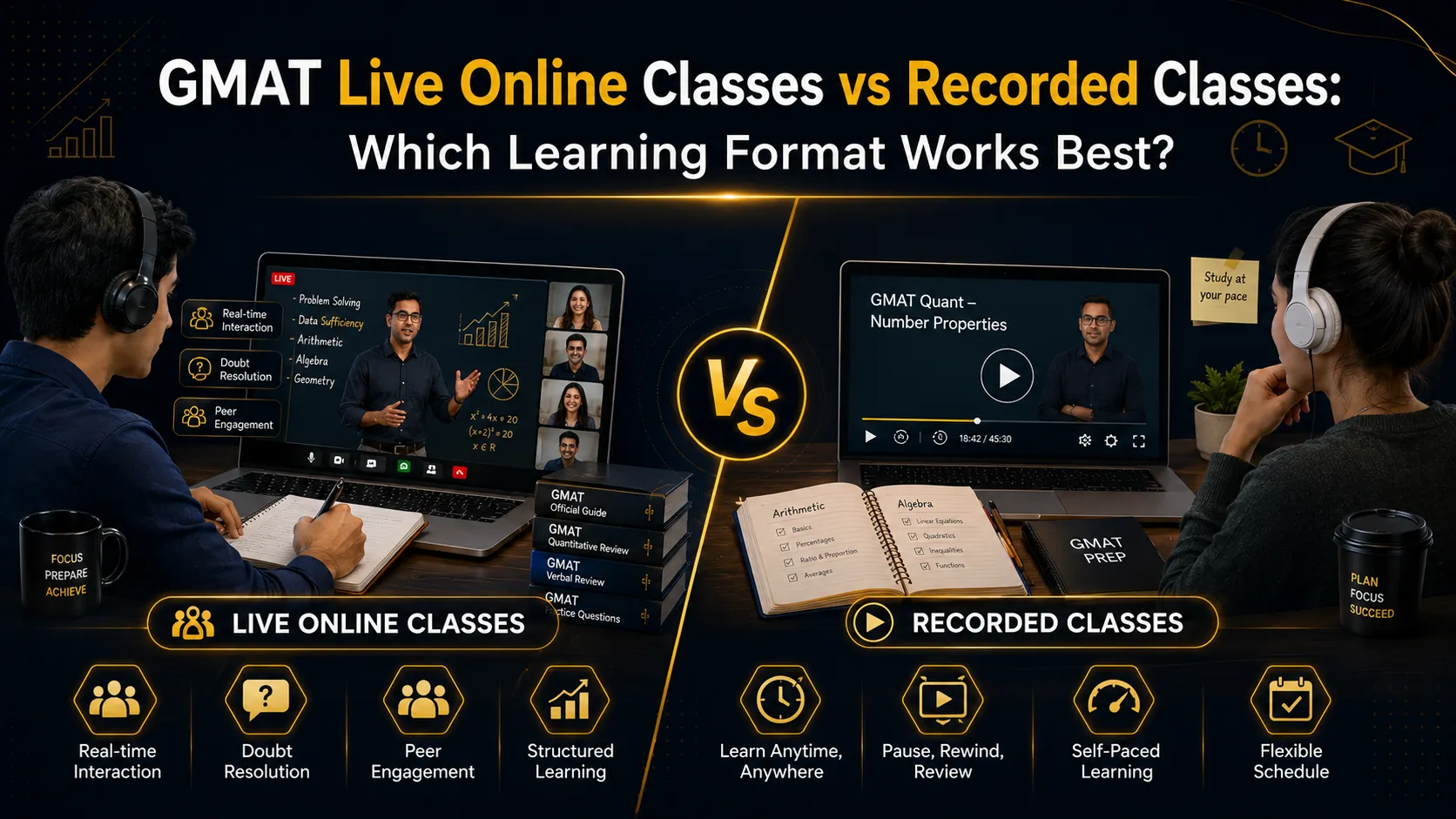
GMAT live online classes offer real-time teaching, direct interaction with trainers and a structured approach to preparation. They are particularly useful for students who want guidance while learning, need help with difficult concepts or are preparing for a high GMAT score. Recorded classes offer greater flexibility and can work well for students who are comfortable studying independently.
The right choice depends on your learning style, schedule and the level of support you need during preparation.
GMAT live online classes vs recorded classes
The main difference is simple: interaction.
With recorded GMAT classes, the lesson is already prepared. You can watch it whenever you want, pause it, rewind it and return to difficult sections later.
With live classes, the trainer is present while you learn. You can ask a question, discuss a solution and clarify a concept before moving ahead.
| GMAT live online classes | Recorded GMAT classes |
| Real-time interaction with trainers | Pre-recorded lessons |
| Immediate doubt clarification | Doubts handled separately |
| Structured class schedule | Completely self-paced |
| Trainer can adapt explanations | Fixed explanation |
| Regular guidance and feedback | Greater flexibility |
| Suitable for students who want support | Suitable for independent learners |
Both formats can work. The important question is which one fits the way you prepare.
For a broader comparison of structured preparation options, you can also explore this guide on how to choose the right GMAT study program.
Why does live teaching help with GMAT preparation?
The GMAT requires more than knowing formulae.
You need to understand what a question is asking, identify the information that matters and choose an efficient way to solve it. This becomes particularly important in Quant, where the conventional mathematical approach is not always the quickest one.
A good trainer can show you alternatives such as substitution, back-solving, approximation, oral calculation and visualisation, and more importantly, explain when each approach makes sense.
That is easier to learn interactively.
A student may understand a solution but still wonder:
"Why did this method work?"
"Could I solve this faster?"
"Why am I getting similar questions wrong?"
A live class gives you the opportunity to ask those questions immediately.
Students interested in understanding the broader benefits of GMAT live online classes can explore how real-time instruction can support their preparation.
What are the limitations of recorded GMAT classes?
Flexibility is the biggest advantage of recorded learning. It can also become its biggest weakness.
When there is no fixed class schedule, it is easy to postpone a lesson. One missed session becomes two, and before long the preparation plan starts slipping.
There is also the problem of individual mistakes.
A recording can explain the correct approach, but it cannot identify why you chose the wrong one. You may replay the lesson and still make the same mistake in practice.
Live instruction gives the trainer an opportunity to understand the reasoning behind the mistake and address it directly.
For students who need regular accountability or find certain concepts difficult to grasp independently, this can make a real difference.
If you are deciding between structured coaching and independent preparation, this comparison of GMAT study programs vs self-study may also be useful.
When are recorded GMAT classes a good option?
Recorded classes can be effective for students who are comfortable managing their own preparation.
They may suit you if you:
- Have an unpredictable schedule.
- Prefer completely self-paced learning.
- Have strong fundamentals.
- Need lessons mainly for revision.
- Can consistently follow your own study plan.
- Are comfortable identifying and correcting your mistakes.
Recorded material can also complement live learning. A student may attend a live session, practise independently and revisit a recorded explanation while revising a topic.
So it does not always have to be one or the other.
For students considering independent preparation, the guide on GMAT study program vs self-study provides another perspective on the two approaches.
Are GMAT live online classes suitable for working professionals?
Yes, provided the programme offers batches that fit around your work schedule.
For working professionals, the challenge is often consistency rather than motivation. After a full day at work, it is easy to postpone a self-paced lesson.
A live batch creates a fixed commitment.
Our GMAT programme offers weekday and weekend options, including Sunday-only lectures, along with 110+ hours of live training. This gives working professionals more flexibility without removing the structure of a scheduled class.
The online format also removes the need to travel to a classroom, which can make a regular study schedule easier to maintain.
Students can also explore GMAT preparation resources to understand the available preparation approach in more detail.
What should you look for in a live GMAT course?
"Live" should not be the only deciding factor.
Before joining a GMAT online coaching programme, look at the complete learning experience.
Check whether it includes:
- Experienced trainers who can explain concepts clearly.
- Regular practice and question-solving.
- Mock tests to measure progress.
- Comprehensive study material.
- A proper doubt-solving system.
- Flexible batches.
- Individual support when required.
Our current programme includes 24x7 doubt-solving support, mock tests, study material and personal training options alongside live instruction.
These elements work together. Classes build understanding, practice develops application and mock tests show how that preparation translates under exam conditions.
If mock tests and performance tracking are important to you, you can also read about GMAT prep courses with mock tests and analytics.
How does our approach to GMAT teaching work?
We focus on concepts before formulae.
Our teaching methodology begins with the fundamentals and focuses on the "how" before moving into the why, what and when. The aim is to develop problem-solving intuition rather than make students dependent on memorised procedures.
This approach is particularly useful when a student knows the basics but struggles with unfamiliar questions.
The same philosophy also comes from Mitul Gada's experience with mathematics. He has spoken about struggling with the subject as a student and later developing a different way of understanding mathematical concepts.
In our batches, students come with different academic backgrounds and different levels of confidence in Quant. Live interaction allows the explanation to change when a particular concept is not clear.
That is difficult to reproduce with a fixed recording.
Students who want to understand more about the features that matter when selecting a structured programme can also review this guide to choosing the right GMAT study program.
How much live GMAT training do you need?
There is no number of classroom hours that guarantees a particular GMAT score.
The requirement depends on your starting level, target score and preparation needs.
What matters is how those hours are used.
Our current GMAT programme includes 110+ hours of live training, supported by mock tests, study material and doubt solving.
That gives students enough classroom time to work through concepts and different types of questions rather than rushing through the syllabus.
But classes are only one part of preparation. Regular practice and careful analysis of mistakes remain essential.
Time management is another important part of exam preparation. Students can learn more about this through our guide on how GMAT prep courses improve time management skills.
How do you decide between live and recorded GMAT classes?
Consider your preparation habits honestly.
Choose recorded classes if you are disciplined, prefer flexibility and are confident creating and following your own study plan.
Choose live classes if you learn better through explanation, need regular structure, ask questions frequently or want feedback on your approach.
Your target score matters as well.
For a high score, completing the syllabus is only the beginning. You need to understand your mistakes, become more efficient and handle questions that do not look exactly like the ones you have practised.
That is where regular interaction with an experienced trainer can be useful.
You can also compare different approaches through this guide on how to choose a GMAT study program that supports better preparation.
Can you try a GMAT class before enrolling?
Yes, and it is worth doing.
A course can have excellent study material and an impressive list of features, but the teaching style still has to work for you.
We offer free trial classes so prospective students can experience the teaching before enrolling. The current website advertises 21 hours of free trial classes.
Use the trial to see how concepts are explained, how questions are approached and whether you are comfortable asking doubts.
That will tell you more than comparing course brochures.
Choosing the right way to prepare
Recorded classes give you flexibility. GMAT live online classes give you flexibility while retaining the interaction and structure of a classroom.
For students who want guidance, regular doubt solving and an opportunity to learn different ways of approaching GMAT questions, live training can be a strong choice.
At Mitul Gada & Associates, our focus is on concept-based teaching, live interaction and consistent practice. We want our students to understand the reasoning behind a solution, not simply remember the answer.
If you are considering live GMAT preparation, you can visit Mitul Gada & Associates and explore the available GMAT preparation options.
Attending a trial class is the simplest way to decide whether the format and teaching approach suit you.
Frequently asked questions
1. Are GMAT live online classes better than recorded classes?
Live classes are generally better for students who need structure, interaction and feedback. Recorded classes suit students who are comfortable studying independently.
2. Can working professionals join live GMAT classes?
Yes. Weekend and Sunday-only batches can make structured preparation easier to fit around professional commitments.
3. Can I ask questions during a live GMAT class?
Yes. Students can interact with the trainer and clarify concepts or solutions during the class.
4. How many live GMAT training hours are provided?
Our current GMAT programme includes 110+ hours of live training, along with mock tests, study material and doubt-solving support.
5. Does the programme provide doubt-solving support?
Yes. We provide 24x7 doubt-solving support as part of the GMAT preparation programme.
6. Can I attend a trial class?
Yes. Free trial classes are available, with 21 hours currently advertised on the website.
7. Is live coaching enough to get a 700+ GMAT score?
No course can guarantee a particular score. Coaching provides guidance and structure, but consistent practice, mock-test analysis and individual effort remain essential.
.webp)