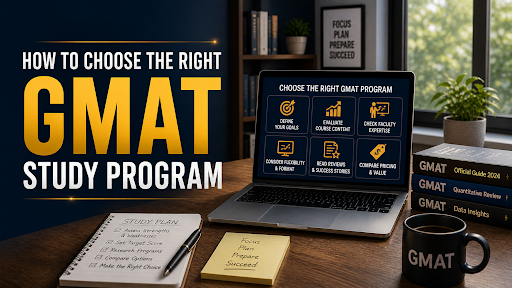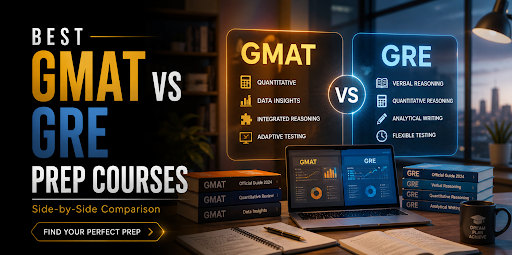

Preparing for the GMAT is a serious commitment. Whether you are seeking admission into one of the top business schools globally or want to improve your MBA application, your preparation strategy is as important as your preparation itself. Many students struggle with one important question: Should you enroll in structured GMAT study programs or rely on self-study?
At our institute, we have helped numerous students with different backgrounds and preparation goals: working professionals, fresh graduates, and even retakers of the GMAT exam. Each of our students is unique and different from one another, yet they share a similar dilemma. Let’s look at both aspects of GMAT preparation and understand what is best for you and your preparation goals.
Understanding the GMAT: Why Strategy Matters
The GMAT is not simply a test of your math or English knowledge. The exam assesses your:
- Quantitative Reasoning
- Verbal Reasoning
- Data Interpretation and Critical Thinking
Many students assume that being good at math or English is enough. In reality, success depends on structured preparation, exam strategy, and consistent feedback.
That’s where the difference between guided learning and self-study becomes important.
The Case for Self-Study
Self-study is an attractive option for many students due to its flexibility and low-cost requirement. It may seem doable with the availability of resources on the Internet and study materials.
Benefits of Self-Study
- Flexible timing
- Self-paced learning
- Low investment
- Recommended for very disciplined learners
Self-study is recommended for learners who are naturally good at organizing their own study plans and schedules. It is recommended for learners who are good in basics and require minimal revision.
Challenges of Self-Study
We have observed that most learners underestimate the challenges involved in this mode of preparation. We have listed them as follows:
- Lack of a study roadmap
- Inability to address weak areas
- Inadequate exposure to advanced learning techniques
- Inability to track performance
- Inability to clear doubts with experts
The major challenge with self-study is that learners may end up practicing and practicing without seeing improvement in their scores because they are practicing their mistakes repeatedly.
The Structure and Support of Guided Preparation
This is where GMAT study programs can have a major impact. A structured program is not just about teaching; it is about a complete teaching system.
From our experience, here are some ways in which our students have benefited:
- A well-designed curriculum that matches the latest GMAT format
- Clear understanding of concepts before practice
- Doubt-solving sessions
- Timed practice in a simulated environment
- Analytics to measure performance
A structured program ensures that preparation is not arbitrary. Every step in the preparation process builds on the last step to build up both accuracy and speed in the student.
Personalized Mentorship: The Hidden Advantage
One of the greatest differences between self-preparation and guided preparation is mentorship.
Most students are unclear about:
- When to take mock tests
- How to analyze mock results
- How to go from a 650 to a 720+
- How to overcome test anxiety
With professional help, preparation is strategic rather than reactive. Mentors can assist in analyzing patterns of error, improving test preparation techniques, and maximizing performance.
We have witnessed our students make tremendous progress once they realize that they are not only preparing to take the GMAT, but also preparing to take it accurately.
Accountability and Consistency
Consistency is often the biggest challenge for GMAT aspirants, especially working professionals.
Preparing for the test independently demands high self-discipline. After a hard day at work, it is easy to put off test preparation.
A structured program provides:
- Regular classes
- Fixed milestones
- Weekly targets
- Scheduled mock tests
This external pressure ensures that the students remain on track. It also helps to foster a learning environment among peers, keeping them motivated to study with others who have the same aspirations.
What About Cost?
The most common reason for students not joining a coaching program is the high cost.
However, if we consider self-study, we need to factor in:
- The number of months we may take to reach our target score
- The cost incurred in retaking the test
- The opportunity cost in terms of delayed applications
If structured preparation helps you achieve your target score faster and in one attempt, the overall investment may be justified.
Who Should Choose Self-Study?
If you are someone who can use self-study, then you should:
- Have already taken the test and know the format
- Are very close to your target and just need a little more
- Are extremely self-disciplined and structured
- Have high analytical skills
However, even in self-study, it is advisable to take mock tests and analysis from a mentor.
Who Benefits More from Guided Programs?
Students who generally benefit more from structured preparation before taking a test are:
- First-time students
- Working professionals with limited time
- Students targeting 700+ scores
- Students who are poor at time management
- Students who are plateauing
In these cases, structured learning is more effective than scattered learning.
Real Score Improvement: What Makes the Difference?
From our understanding and experience, students who score better are those who:
- Understand concepts before focusing on speed
- Take regular sectional tests
- Undergo detailed mock analyses
- Improve strategies
- Get constant feedback
Many students who start learning on their own soon realize that they need guidance to improve scores beyond a particular level.
The difference is not about intelligence; it is about approach.
A Balanced Perspective
It is vital to grasp the fact that not all methods are perfect for everyone. Some people learn independently, while others need assistance.
What is important to consider:
- Your current score level
- Your target score
- Your timeline
- Your learning style
If you are looking to make a moderate improvement, you can opt to study on your own, especially if you possess good time management skills. However, if you are targeting top-notch business schools with high percentiles, you may require professional learning to give you that competitive edge.
Making a Strategic Decision for Long-Term Success
When making a strategic decision between self-study and structured learning, you need to consider the outcomes, efficiency, and ease of understanding.
A well-designed GMAT study program will give you the structure you need to prepare, the mentoring you need to succeed, the mock tests you need to simulate the real test, and the tracking you need to monitor your progress, which might not be the case with independent study. On the other hand, independent study requires discipline, planning, and the ability to identify your own weaknesses.
In the current day and age, students are looking for the best GMAT coaching, GMAT preparation, online GMAT course, online GMAT mock tests, and online GMAT strategy sessions. Students must choose the best method of preparation, as it can have a major impact on the score.
At Mitul Gada & Associates, we are committed to helping students build strong foundations, improving strategy, and providing mentorship, so students can learn with clarity and confidence rather than confusion.
The method of preparation that can get you the best score is the method that suits you best. It is not just hard work, but strategic preparation towards your goal.
.webp)