Preparing for the GMAT is far more than just doing practice questions or viewing videos. Success relies on knowledge of the concepts, using reasoning under pressure and the ability to retain the learning for weeks or months after the initial preparation. There are a number of methods taught that will help them get better grades, but one method is used for a very good reason, and that is it keeps students engaged in the learning process.
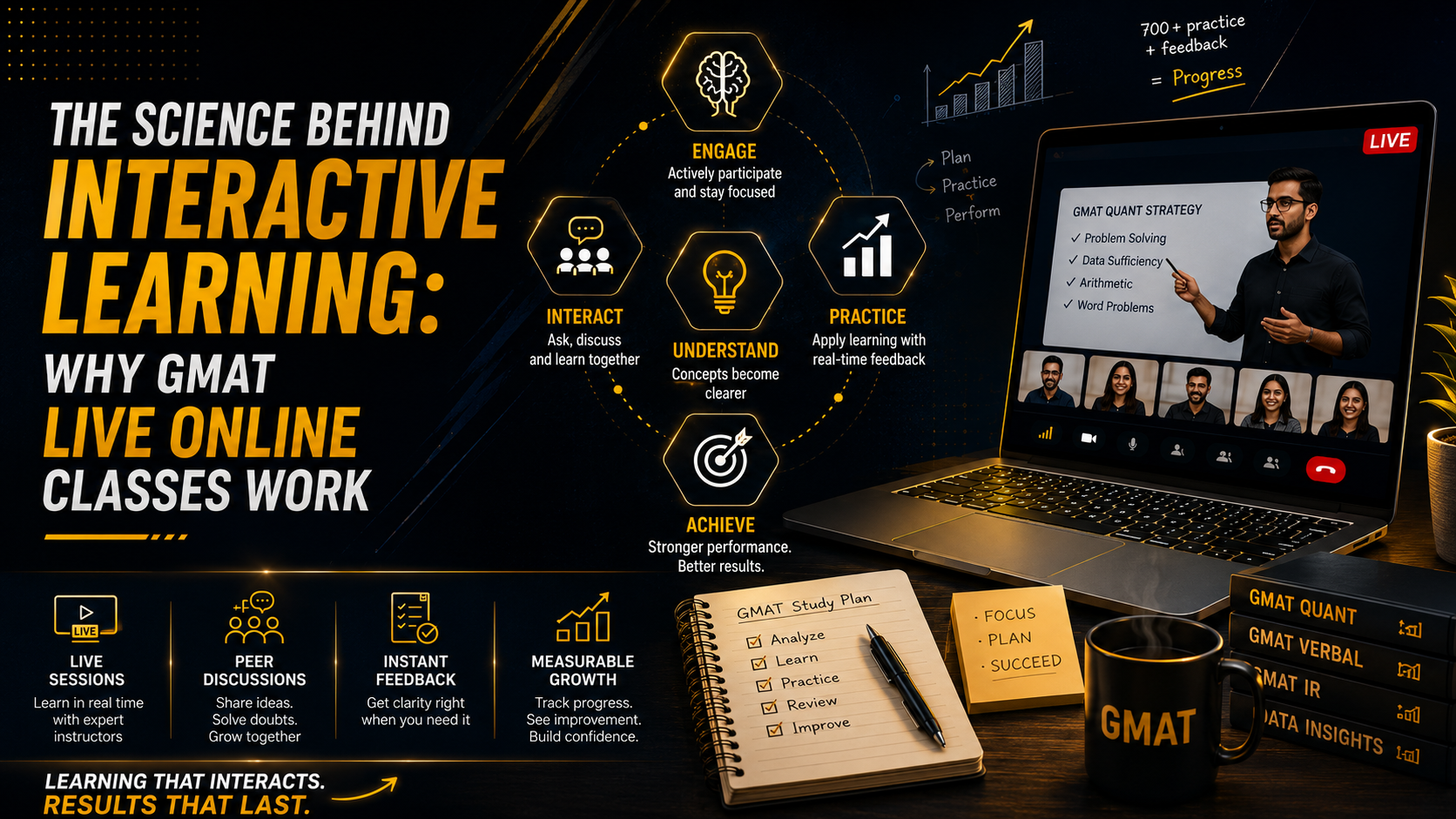
GMAT live online classes are not just a technology or convenience. It involves making a space in which students can think, engage, ask questions, be able to solve problems, and be provided with guidance right away, rather than listening to a teacher.
To understand why this approach works, let's step inside a typical interactive GMAT class and examine what happens from the moment students prepare for the lesson until they revisit those concepts long after the session ends.
What Actually Happens Inside an Interactive GMAT Class?
An engaging class is designed as a continuous learning cycle rather than a one-way lecture.
Inside One Interactive GMAT Class
Stage 1 – Prepare
Prior to joining the session, review previous concepts and ask questions.
Stage 2 – Learn
The teacher gives an explanation of a concept in a practical example and makes students think before giving the answers.
Stage 3 – Participate
Students solve questions, explain their answers, and compare alternative methods.
Stage 4 – Receive Feedback
Wrong assumptions are rectified right away and other approaches are considered.
Stage 5 – Reinforce
The concepts are further practiced post class via assignment and revision, allowing them to become more familiar over time.
Each level serves a purpose. Rather than just teaching the content, interactive learning involves students in the process of developing understanding over time.
Before Class: Preparing the Mind to Learn
Great learning doesn't really begin when the teacher begins talking. It begins before the first class even begins.
Students review previous notes for a few minutes, review questions that were difficult, or go back to questions that need clarification. This minimal preparation will help trigger prior learning that will facilitate the linking of new ideas to prior understandings.
Students who enter class with clear objectives often:
- Recognize patterns more quickly
- Ask more meaningful questions
- Participate with greater confidence
- Follow complex explanations more easily
- Retain new information more effectively
They don't come empty-handed, but rather with something to build upon.
During Class: Participation Replaces Passive Learning
The most significant difference between an interactive class and a recorded lecture is the degree of mental involvement.
Instead of passively watching an instructor work out a problem, students are encouraged to think before they are discussed. They try out questions, make explanations, compare strategies and speculate on how one might be more effective than another.
This process will shift the learner from an observer to a participant.
During an interactive session, students commonly:
- Solve questions before reviewing solutions
- Predict the next logical step in a problem
- Compare multiple solving techniques
- Discuss reasoning behind different answers
- Clarify doubts immediately instead of postponing them
The brain has to remember information, not just identify it, for every interaction. That's a big impact on learning for that small difference.
Why Students Remember More After Discussing Than Reading
Most people assume reading the same notes repeatedly will improve memory. While repetition has value, discussion often creates stronger and longer-lasting understanding.
When students explain how they reached an answer, they organize their thoughts more carefully. When they hear classmates approach the same problem differently, they expand their own reasoning instead of relying on a single method.
Discussion also exposes misunderstandings that silent reading may never reveal.
Think about a Data Insights question. Reading the explanation tells you what the correct answer is. Explaining the reasoning behind that answer forces you to understand why every incorrect option fails.
That deeper level of processing makes concepts easier to remember later.
Interactive classrooms naturally create opportunities for students to:
- Explain ideas aloud
- Defend their reasoning
- Learn alternative approaches
- Identify gaps in understanding
- Build stronger conceptual connections
These moments transform information into usable knowledge.
Immediate Feedback Prevents Small Mistakes From Becoming Habits
Mistakes are a natural part of GMAT preparation. What matters is how quickly they are identified and corrected.
Imagine solving several Quant questions using the same incorrect assumption. If no one points out the flaw immediately, that mistake may continue through dozens of practice sessions before being discovered.
Interactive learning shortens that cycle.
Instead of waiting until the weekend to review errors, instructors provide clarification while the concept is still fresh.
Immediate feedback helps students:
- Correct reasoning before it becomes habitual
- Understand why an answer was incorrect
- Learn more efficient problem-solving methods
- Build confidence through timely clarification
- Move forward without carrying confusion into future lessons
It's good to hear back. Understanding why the answer is correct means that future performance improves.
Practice After Class Turns Understanding Into Retention
The learning doesn't stop after the live session.
Many concepts are reinforced after class.
Students revisit similar question types, complete structured assignments, and apply the same reasoning independently without instructor support. This repeated retrieval strengthens memory while improving confidence in unfamiliar situations.
Rather than memorizing solutions, students gradually recognize recurring patterns across different GMAT questions.
Effective post-class practice often includes:
- Revisiting concepts introduced during class
- Solving new questions using the same principles
- Reviewing incorrect answers carefully
- Tracking recurring mistakes
- Measuring improvement over time
All of the practice sessions are to review the material covered in the live discussion.
Why Some Concepts Stay With You Long After the Lesson Ends
Have you ever noticed that some ideas stick in your mind for months, some for days?
The distinction is frequently in the way the concepts were learned.
Explanation, discussion, practice, correction and repeated application of ideas generates multiple memory connections. Students start to identify logical relationships among different types of questions rather than just memorizing formulas.
After a while they stop asking, "What formula should I use?
Rather, they begin asking "What is this question really testing?
Changing their perspective is one of the most significant signs of learning.
Myth vs. Reality
| Myth | Reality |
| Live online classes are just video lectures. | Interactive classes encourage continuous participation and discussion. |
| Watching more lessons automatically improves scores. | Applying concepts through active problem solving leads to stronger understanding. |
| Asking questions interrupts learning. | Clarifying doubts early often prevents repeated mistakes later. |
| Reading notes repeatedly is the best revision strategy. | Solving, discussing, and explaining concepts improves long-term retention more effectively. |
What Separates an Engaging Live Class From an Ordinary Online Lecture?
Technology can be shared between two classes, and it can be used in different ways, resulting in very different learning experiences.
A typical online lecture is about one-way transmission of information from teacher to student. There is only limited interaction and the students listen to a lot.
An engaging live class, on the other hand, keeps students engaged in the learning process all the time.
You'll often notice that engaging sessions encourage students to:
- Think before answers are explained
- Solve questions independently
- Ask questions throughout the lesson
- Compare multiple solving strategies
- Reflect on mistakes immediately
- Continue structured practice after class
The emphasis shifts from simply completing lessons to developing stronger reasoning skills.
What This Means for Your GMAT Preparation
Taking the GMAT is all about developing the skills to think clearly, apply concepts with confidence, and solve new problems in test-taking mode. Interactive learning contributes to all of these objectives with respect to the way students are engaged in the learning process, as they are not observed, but are active participants.
The benefits of GMAT live online classes are in the reasoning that students refine after the explanation and in the questions they are able to ask, the discussions they are able to participate in, the errors they are able to fix and the reasoning they are able to strengthen with repeated practice. Those experiences foster greater understanding which carries beyond the classroom.
At Mitul Gada & Associates, we believe meaningful preparation for the GMAT starts with great concepts and active engagement. The interactive live sessions are designed to foster thoughtful discussion, continual feedback and problem solving to ensure students gain confidence and develop good exam skills. We are mentors and are excited to help each learner prepare with clarity, consistency and a learning approach that will lead to long term success.
Frequently Asked Questions
1. Why do GMAT Live Online Classes help students learn more effectively?
They encourage active participation, immediate feedback, and continuous practice, helping students understand and retain concepts more effectively than passive learning methods.
2. Is discussion really important during GMAT preparation?
Yes. Discussing different solving approaches strengthens conceptual understanding and exposes students to multiple ways of thinking about the same problem.
3. How does immediate feedback improve GMAT preparation?
Immediate clarification prevents incorrect reasoning from becoming a habit and helps students refine their problem-solving strategies while concepts are still fresh.
4. Are live online classes suitable for students preparing while working full-time?
Many students find live online classes helpful because they provide structured learning, regular accountability, and opportunities to ask questions without attending a physical classroom.
5. What makes an engaging GMAT live class different from a regular online lecture?
An engaging class encourages participation, discussion, guided practice, and continuous interaction instead of relying only on one-way instruction.
6. Can interactive learning improve long-term retention for the GMAT?
Yes. Repeated practice, active recall, meaningful discussions, and timely feedback work together to strengthen memory and make concepts easier to apply during the exam.